
TL;DR:
- Practicality, familiarity, and size dominate best-selling mug choices.
- Ceramic remains the leading material due to heat retention and durability.
- Artisanal and custom mugs appeal for their craftsmanship and unique design.
Most people assume a best-selling mug is simply the one with the best reviews or the flashiest design. The reality is more nuanced. Classic ceramic mugs in 11–15 oz sizes consistently top sales charts not because they're the most beautiful, but because they hit a sweet spot of practicality, familiarity, and price. For coffee and tea enthusiasts who care about ritual and craftsmanship, that's only part of the story. This guide unpacks what actually drives best-sellers, from hard sales data to the subtle artistry that separates a mug you tolerate from one you genuinely love.
Table of Contents
- What do the numbers say? The anatomy of best-selling mugs
- What makes a mug practical? Key buying factors explained
- Artisanal mugs: The craft behind the cult favourites
- Design, value, and the expert edge: What signals quality in mugs?
- Why the best mug often isn't the bestseller, and why that matters
- Discover your next best-loved mug with Muggie
- Frequently asked questions
Key Takeaways
| Point | Details |
|---|---|
| Most sold mug sizes | Classic 11–15 oz ceramic mugs top sales for their practicality and comfort. |
| Artisanal appeal | Handmade mugs offer unique design and enhanced sensory experience, making them prized gifts. |
| Essential features | Heat retention, safety, durability, and easy cleaning are critical for both daily use and gifting. |
| Quality signals | Manufacturing technique and mug shape reveal true value far beyond brand names or price tags. |
What do the numbers say? The anatomy of best-selling mugs
Sales data tells a clear story. The most popular mugs aren't the most elaborate ones. They're the ones people reach for every single morning without thinking twice.
Size is the first filter. Ceramic mugs in 11–15 oz sizes dominate global sales because they hold a standard serve of coffee or tea without feeling oversized or underwhelming. That translates to roughly 325–450ml, which covers everything from a strong flat white to a generous cup of English Breakfast. Smaller options like the popular 250ml cone mug cater to espresso drinkers who want a precise, elegant vessel.

The material breakdown matters more than you'd expect. The global mug market will reach $11.34 billion by 2034, with ceramic holding a commanding 42% market share. That dominance reflects something real: ceramic retains heat well, feels good in the hand, and survives daily use with minimal fuss. Alternatives like stainless steel, glass, and stoneware fill specific niches, but ceramic remains the baseline against which everything else is measured.
| Category | Key appeal | Typical size range |
|---|---|---|
| Everyday ceramic | Practical, affordable, durable | 11–15 oz (325–450ml) |
| Artisanal stoneware | Unique glaze, heat retention, craft | 8–14 oz (240–415ml) |
| Espresso / small-serve | Precision, aesthetics | 2–4 oz (60–120ml) |
| Travel mugs | Portability, insulation | 12–20 oz (355–590ml) |
| Gift sets | Curation, presentation | Varies |
What's interesting is how the gift segment behaves differently. Mugs bought as gifts are more likely to sit in the premium tier, where design and story matter as much as function. A beautifully shaped elegant pink goblet mug makes an impression that a generic ceramic never could.
Custom and promotional mugs are the fastest-growing niche, driven by print-on-demand platforms and corporate gifting. But for everyday enthusiasts, the core truth remains: simple, well-made ceramics with clean lines and the right weight consistently outperform novelty items over time. Browse the full ceramic coffee mugs collection to see how thoughtful curation differs from mass-market offerings.
- Practicality and size familiarity drive volume sales
- Ceramic holds 42% of the global mug market
- Gift and custom mugs are growing but serve distinct buying motivations
- Small-serve options like the 250ml cone suit espresso rituals perfectly
- Simplicity in design consistently outlasts trend-driven novelty
What makes a mug practical? Key buying factors explained
Data is just one side. Now, let's look at what buyers and enthusiasts really want from their favourite mugs.
The moment you pick up a mug, you're already making a judgement. Weight, balance, handle size, lip thickness: every tactile element sends a signal before a single sip. This isn't superficial. How a mug feels in your hand shapes the entire experience of the drink inside it, which is why mug design shapes sensory experience in ways most people don't consciously register.
Material safety is non-negotiable. Key buying factors include heat retention, material safety, durability, ergonomics, and being microwave and dishwasher safe. For everyday use, a mug that leaches lead or BPA into hot liquid isn't just unpleasant, it's a genuine health concern. Food-safe ceramics fired at high temperatures eliminate that risk entirely. That's why reputable artisan makers specify food-safe glazes as a baseline, not a bonus.

Heat retention is the factor most buyers underestimate until they've experienced it firsthand. A thin-walled mug loses heat fast. A well-made stoneware piece with thicker walls keeps your coffee at a pleasant temperature for longer, which matters enormously if you're someone who gets distracted mid-cup. The difference is especially noticeable when comparing ceramic mug design choices across different wall thicknesses and kiln temperatures.
Durability and ease of care drive repeat purchases more than almost anything else. A beautiful mug that chips on first contact with the dishwasher rack is a frustrating experience. Mugs that are clearly marked as dishwasher safe, and genuinely hold up to that claim, build loyalty fast. This is why so many gift buyers gravitate toward ceramics that combine aesthetics with obvious longevity. Thoughtful gifting mug designs balance visual appeal with confidence that the piece will last.
Pro Tip: When choosing your perfect mug, always check for food-safe, lead-free glaze certification and confirm dishwasher compatibility. A mug that's genuinely easy to live with will become your favourite far quicker than one that demands careful handling.
- Food-safe, BPA and lead-free materials
- Good heat retention through wall thickness and quality firing
- Comfortable handle with enough finger room
- Microwave and dishwasher safe for everyday ease
- Weight and balance that feel intentional, not heavy or flimsy
Artisanal mugs: The craft behind the cult favourites
Beyond mass-market practicality, there's an entire world of mugs defined by their artistry.
When you pick up a handmade ceramic mug for the first time, there's usually a moment of surprise. It feels different. The glaze has depth. The walls have a slight variation in thickness that machine-pressed pieces never show. That variation isn't a flaw; it's evidence of a human hand at work.
Glazes are where artisan makers truly distinguish themselves. A good glaze isn't just decorative. It affects surface texture, how the mug feels against your lips, and even how easy it is to clean. Some glazes develop a subtle patina over time, making each mug genuinely unique after months of use. Artisanal handmade mugs are prized for unique glazes, thick walls for heat retention, and high-fired stoneware for strength, and cult brands consistently deliver on all three.
| Feature | Artisanal mug | Mass-market mug |
|---|---|---|
| Glaze character | Hand-applied, unique variation | Uniform, machine-applied |
| Wall thickness | Intentionally considered | Standardised thin |
| Firing temperature | High-fired stoneware | Often earthenware, lower temp |
| Visual uniqueness | Each piece slightly different | Identical across batches |
| Price point | Premium, reflects labour | Budget to mid-range |
The wall thickness in quality stoneware isn't accidental. Thicker walls require more clay and more skilled forming, but they pay back that investment in noticeably better heat retention and a more satisfying weight. You'll notice this when comparing a well-made artisan piece with a promotional mug from a supermarket shelf. The difference is immediate.
This is also what drives the gifting premium. When someone receives a handmade mug, they recognise something in it: the care and craftsmanship in design that a standard piece simply doesn't communicate. It says something about the person who chose it.
"The best mug is the one you reach for first, before you've even thought about it. That instinct is usually design doing its job quietly."
Design, value, and the expert edge: What signals quality in mugs?
So, how can you spot true value beyond branding and price?
The gap between a genuinely well-made mug and a convincingly packaged ordinary one is real, but it's not always visible at first glance. Knowing what to look for changes how you shop entirely.
Manufacturing method is the single biggest signal. Manufacturing techniques and shape are the strongest predictors of value in high-end ceramics, according to recent machine learning analysis applied to ceramic heritage objects. High-temperature kiln firing, hand-throwing on a wheel, and careful trimming all leave traceable marks on the finished piece. Even without a trained eye, you can feel the result.
Shape affects more than aesthetics. A narrower rim concentrates aroma differently than a wide, open bowl. A tapered base changes how heat distributes. These aren't trivial details; they genuinely influence how coffee or tea tastes and smells. Enthusiasts who experiment with different shapes often report surprising differences in their morning experience, even using identical beans or leaves.
- Check the base of the mug for a maker's mark or stamp, which signals intentional production
- Run your finger along the interior glaze: smooth, even coverage with no rough patches is a positive sign
- Hold the mug and feel whether the weight is centred or top-heavy
- Look at the handle attachment points: clean joins indicate careful craftsmanship
- Tap the rim lightly: a clear, resonant ring usually indicates well-fired, dense stoneware
Pro Tip: Learning to care for ceramic mugs properly extends their life significantly. Avoid sudden temperature changes and hand-wash any mug with gold or platinum glaze details to preserve the finish.
For enthusiasts exploring slow coffee and tea ceramics, these signals matter. A mug built with intention gives back that intention every single morning.
Why the best mug often isn't the bestseller, and why that matters
You've seen the data and the details. But what does that really mean for your daily mug choices?
Here's an honest observation: the ceramics that move the most units are often designed for the widest possible audience. They're reliable, safe, and inoffensive. That's genuinely valuable. But for someone who treats their morning coffee or tea as a ritual rather than a task, a bestseller list is a starting point, not a destination.
Mass-market mugs are optimised for cost, volume, and shelf appeal. They're not optimised for your hands, your preferred drink temperature, or the way a particular glaze colour makes you feel at 7am. That gap matters. Gifting someone a carefully chosen artisan piece communicates something a chart-topper simply cannot.
Slow living is built on small, deliberate choices. The mug you reach for every morning is one of those choices. Sales data tells you what most people buy. It doesn't tell you what will make your ritual feel like yours. When you discover your ideal mug by paying attention to craft, feel, and design intention rather than popularity metrics, the difference is felt every single day.
Discover your next best-loved mug with Muggie
If this guide has shifted how you think about what makes a great mug, you're ready to shop with a sharper eye.
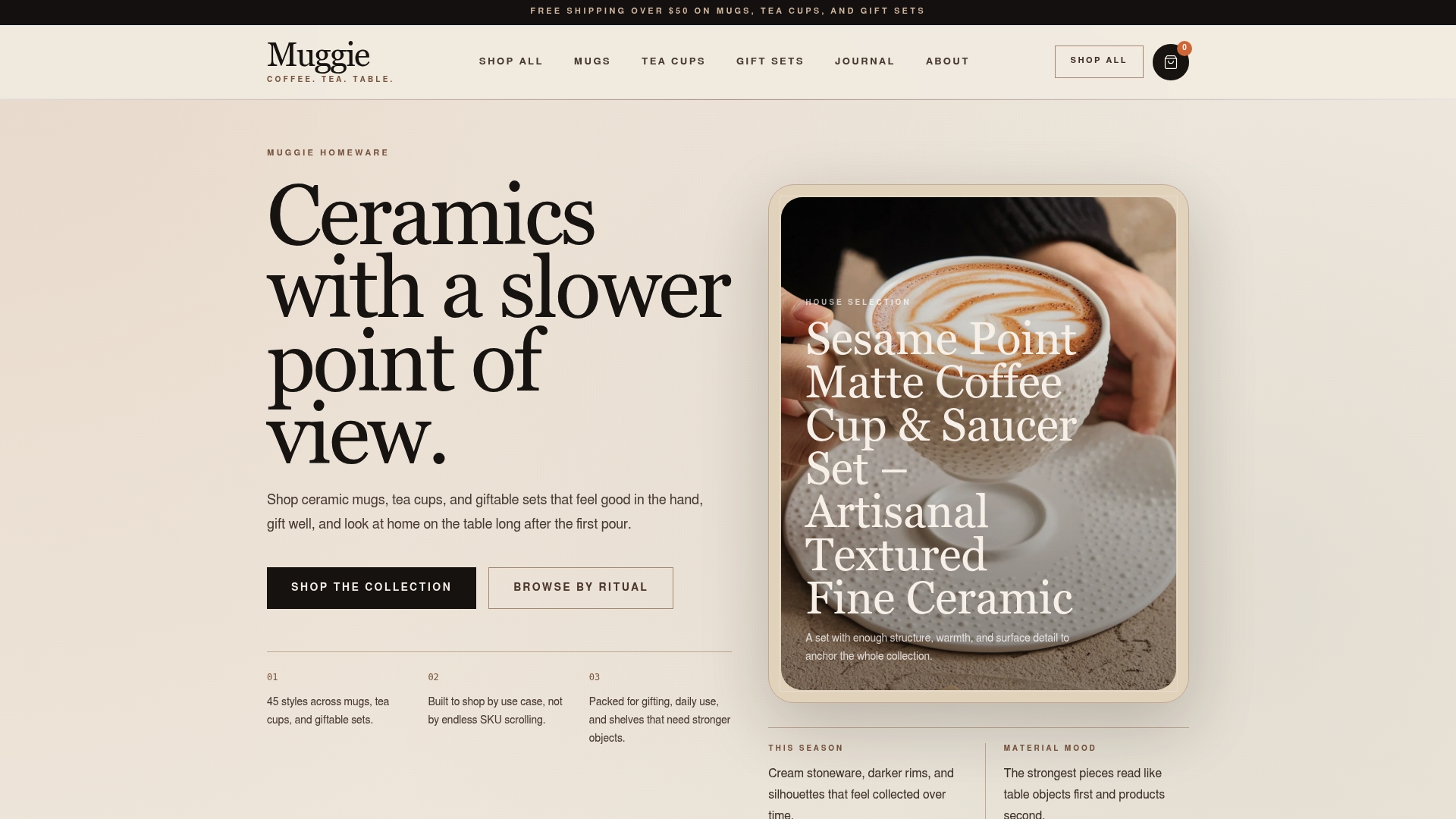
At Muggie, every piece in our collection is handcrafted from food-safe, dishwasher-friendly Australian ceramics, selected for both daily functionality and genuine artisanal character. Whether you're building a personal ritual or looking for a gift that says more than a gift card ever could, our curated range makes it simple. Shop coffee mugs to find your next everyday favourite, browse our giftable sets for beautifully presented options, or explore all ceramics to discover what slow mornings are really made of.
Frequently asked questions
What are the most popular mug sizes for coffee and tea?
Classic sizes of 11–15 oz (325–450ml) sell best, balancing practicality and comfort for most drinkers. Smaller 250ml options suit espresso and short-serve drinks well.
Why do artisanal mugs cost more than regular ones?
Handmade mugs command higher prices because of unique glazes, thick walls, and high-fired stoneware construction that takes significantly more skill and time to produce.
What practical features should I look for in a daily mug?
Prioritise mugs that are microwave and dishwasher safe, free from BPA and lead, ergonomically comfortable to hold, and made from durable, food-safe materials.
Do shape and manufacturing method really affect mug quality?
Yes. Manufacturing techniques and shape are reliable predictors of value in high-end ceramics, with shape influencing both taste experience and comfort in the hand.
Are custom and gift mugs a growing market trend?
Absolutely. Personalised and promotional mugs are one of the fastest-growing segments within the global mug market, driven by corporate gifting, print-on-demand platforms, and the broader gifting culture.