
TL;DR:
- Handcrafted tableware is shaped and finished with human involvement at every stage, resulting in natural variation and character. Choosing artisan-made ceramics reflects values of attention, individuality, and support for local craft traditions, often at a higher cost but with greater emotional and aesthetic significance. These unique pieces enhance daily rituals and meaningful gifting, emphasizing care, intentionality, and the beauty of imperfection.
Not all ceramics are created equal, and assuming otherwise is the most common mistake people make when furnishing their tables or choosing a meaningful gift. Mass-produced mugs and plates might look polished in a catalogue, but they carry none of the intention, variation, or story that defines truly handcrafted tableware. As artisan involvement and individuality distinguish handcrafted pieces from factory-uniform alternatives, choosing the right ceramic can shift an everyday cup of tea from a routine into something genuinely nourishing.
Table of Contents
- What defines handcrafted tableware?
- Handcrafted versus mass-produced tableware
- Design and individuality in everyday use
- Selecting handcrafted tableware: Practical considerations
- A personal perspective: Why handcrafted tableware matters
- Embrace handcrafted tableware: Next steps
- Frequently asked questions
Key Takeaways
| Point | Details |
|---|---|
| True craftsmanship | Handcrafted tableware highlights artisan skill and creative expression. |
| Unique designs | Every item reflects natural variations and individuality, making each piece special. |
| Mindful gifting | Giving handcrafted ceramics shows thoughtfulness and appreciation for artistry. |
| Practical selection | Consider durability, care, and authenticity when choosing handmade items. |
| Meaningful everyday use | Handcrafted ceramics enrich daily routines and enhance mindful living. |
What defines handcrafted tableware?
Handcrafted tableware is shaped, glazed, and finished with direct human involvement at every stage of production. Unlike factory output where machines replicate identical forms at scale, an artisan's hands leave their mark on every piece. That mark might appear as a slightly uneven rim, a glaze that pools differently in one mug compared to another, or a texture that rewards touch. These are not flaws. They are evidence of craft.
Handmade vs mass-produced pottery is often framed as a debate about quality, but it is really a conversation about values. What do you want your tableware to say? Factory ceramics say efficiency. Handcrafted ceramics say attention.
The core characteristics that define handcrafted tableware include:
- Artisan involvement at every stage, from raw clay preparation through to glazing and kiln firing
- Natural variation between pieces, meaning your mug and your friend's identical order will differ subtly
- Creative expression baked into the object, reflecting the maker's aesthetic sensibility
- Small-batch production, which limits volume but increases intentionality
- A traceable story, often connecting you to a specific maker, studio, or region
"The imperfection in a handcrafted piece is not a defect. It is the maker's fingerprint, proof that a human being cared enough to shape this object for you."
These qualities transform tableware from a functional item into something with genuine character. When you reach for a handcrafted mug in the morning, you are holding an object that could not be replicated exactly, anywhere else in the world. Exploring handmade mug collections reveals just how much variety and personality artisan makers bring to what many assume is a mundane category.
Handcrafted versus mass-produced tableware
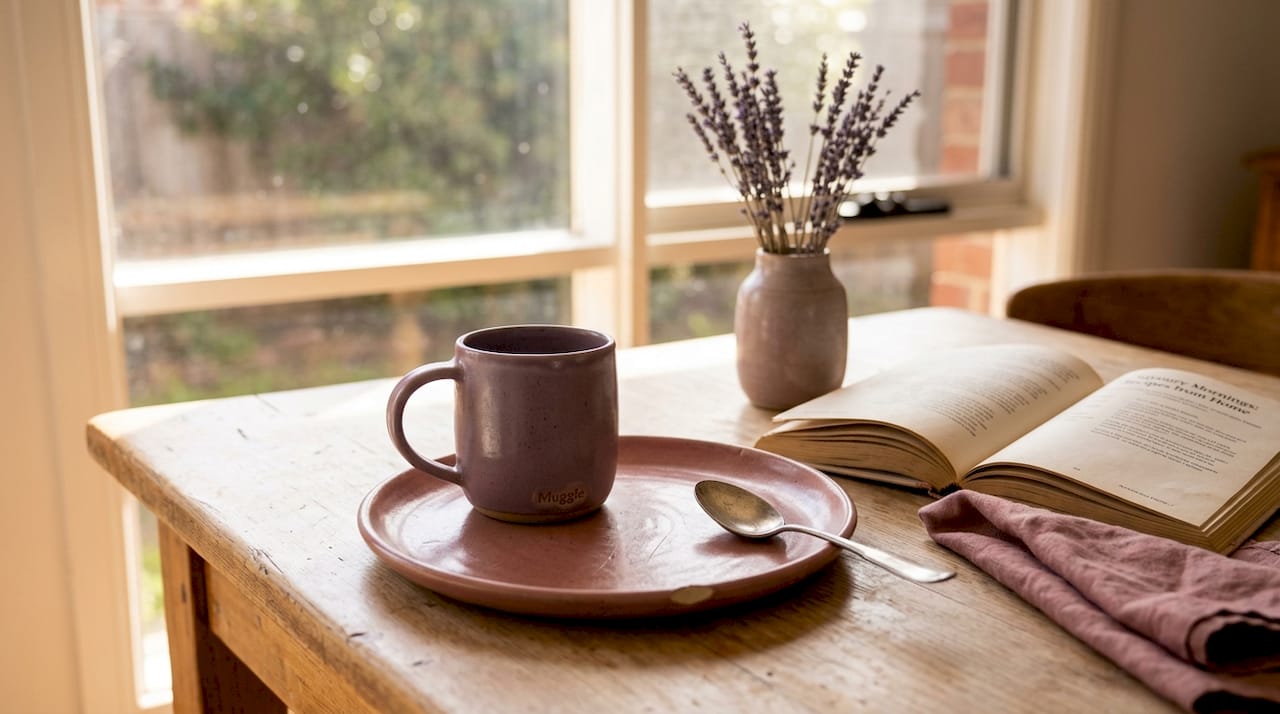
The differences between handcrafted and mass-produced tableware go well beyond aesthetics. They affect cost, durability, lead times, environmental footprint, and the emotional experience of using the object daily. Understanding these trade-offs helps you make confident, informed choices.
| Feature | Handcrafted | Mass-produced |
|---|---|---|
| Appearance | Natural variations, unique character | Uniform, consistent replication |
| Production method | Artisan hands, small batch | Machine processes, high volume |
| Cost | Generally higher per piece | Lower per unit at scale |
| Lead time | May take longer to produce | Immediately available |
| Emotional value | High, connected to maker | Low, anonymous origin |
| Environmental impact | Often lower, local materials | Higher due to shipping scale |
| Durability | Varies by maker and technique | Standardised, predictable |
As small-batch artisan work demonstrates, each handcrafted piece carries natural variations that mass production deliberately eliminates. That elimination is precisely what makes factory ceramics feel cold and interchangeable once you have spent time with artisan ware.
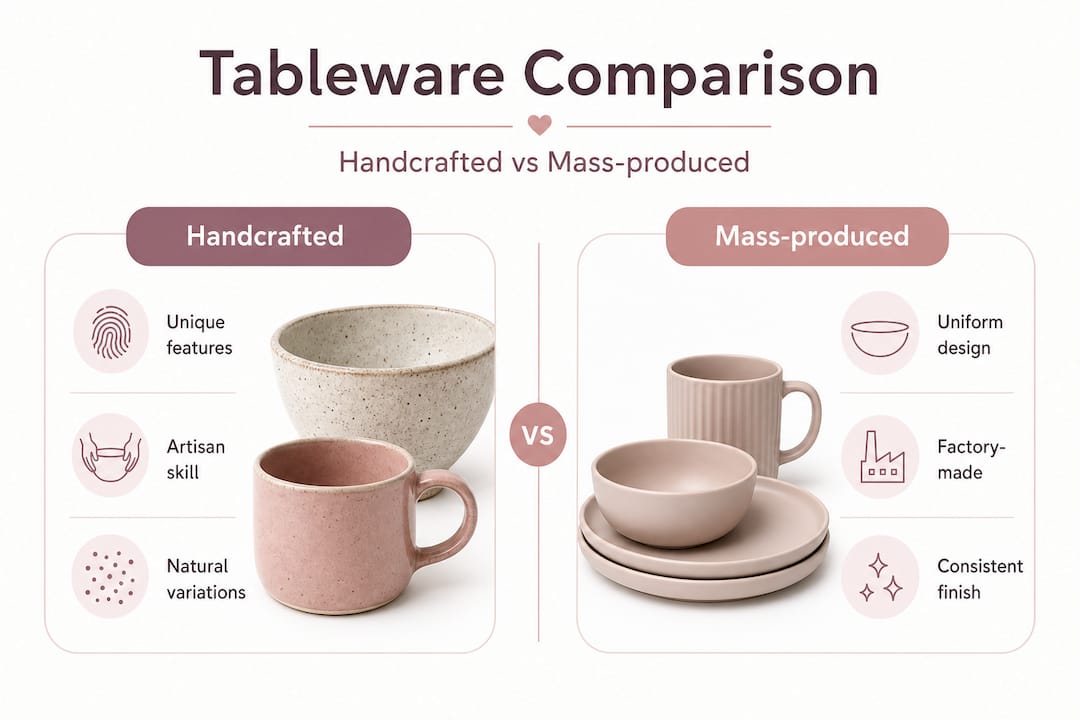
The cost difference is real and worth addressing honestly. A handcrafted mug will typically cost more than a supermarket alternative. But consider what you are actually buying. You are paying for skill, for time, for materials chosen with care, and for the knowledge that no machine produced this object. When you look at unique handmade mugs alongside their factory equivalents, the price gap becomes easier to understand. One is a commodity. The other is an object with a life of its own.
The importance of handmade ceramics extends beyond personal preference. Supporting artisan makers sustains craft traditions, keeps skills alive within communities, and contributes to local economies in a way that buying from a global factory chain never can.
Pro Tip: If the price of a handcrafted set feels steep initially, think about cost per use. A well-made ceramic mug used daily for five years works out to almost nothing per use, and it brings far more pleasure than a cheap replacement.
Design and individuality in everyday use
One of the most underestimated benefits of handcrafted tableware is how it changes the experience of your daily rituals. A morning coffee made in a mass-produced mug is just a morning coffee. The same coffee served in a beautifully glazed, hand-thrown ceramic mug becomes a small ceremony. The warmth of the clay, the weight of the form, the way light catches an uneven glaze edge, these details accumulate into something that genuinely enriches your day.
The individuality of each handcrafted piece means that your table setting can never look entirely like anyone else's. That is a rare quality in a world where most homes are furnished from the same handful of large retailers.
Consider how handcrafted ceramics perform across different everyday scenarios:
| Scenario | What handcrafted adds | Example pieces |
|---|---|---|
| Morning coffee ritual | Tactile warmth, personal connection | Textured mugs with earthy glazes |
| Afternoon tea | Elegance, occasion-worthy feel | Delicate cups with fine detailing |
| Table presentation for guests | Conversation piece, artistic interest | Coordinated sets with varied glazes |
| Gifting for birthdays | Thoughtfulness, uniqueness | Curated gift sets |
| Daily desk use | Comfort, creative inspiration | Robust everyday mugs |
When you think about gifting, handcrafted tableware carries a weight that a generic store purchase simply cannot match. Giving someone a beautifully designed ceramic set communicates that you paid attention to who they are, not just what was on sale. It says you chose something made by a real person, for a real person.
Pieces like a minimalist coffee cup set demonstrate how handcrafted design can occupy a beautiful middle ground between sculptural art and everyday function. The rock texture finish, for instance, is impossible to replicate with a factory mould. It is the direct result of a maker's decision to explore surface and form in a way that serves both aesthetics and grip.
Some of the most compelling design details found in handcrafted tableware include:
- Reactive glazes that shift colour unpredictably during firing, producing one-of-a-kind surfaces
- Wabi-sabi inspired imperfections that align with Japanese philosophies of finding beauty in the irregular
- Tactile textures pressed, carved, or thrown into the clay surface before firing
- Hand-painted details applied with brushwork that cannot be digitally printed
- Form variations in rim profile, foot ring, and wall thickness that affect how a piece feels in your hand
Exploring handmade mug designs gives a clear sense of how dramatically a single form can vary when an artisan treats each piece as a creative expression rather than a production unit.
Selecting handcrafted tableware: Practical considerations
Choosing handcrafted tableware requires a slightly different approach than buying from a major homeware retailer. There are practical factors worth understanding before you invest, whether you are buying for yourself or selecting a gift for someone whose taste you respect.
-
Assess the maker's reputation. Look for artisans or studios with a track record of producing food-safe, well-finished ceramics. Reputable makers will clearly state whether their glazes are food safe and whether pieces are suitable for dishwasher use.
-
Clarify care requirements. Some glazes are sensitive to harsh dishwasher detergents. Others hold up beautifully to daily machine washing. Ask or read the product description carefully, because knowing how to care for your ceramics directly affects how long they last.
-
Consider the recipient's lifestyle. A gift for someone who drinks three coffees a day needs to be a robust, everyday-weight mug. A gift for a tea enthusiast who savours single cups in quiet moments might suit a lighter, more delicate form. Matching the piece to the person is what mindful gifting actually means in practice.
-
Support local where possible. Buying from Australian ceramic makers means your purchase supports local artisans, reduces shipping distances, and keeps craft traditions alive within your own community.
-
Accept and appreciate variation. If you are buying multiple pieces from the same range, expect slight differences. This is not a quality control issue. It is the defining characteristic of handcrafted work, and it means your set will have a personality that a factory-perfect set never could.
-
Think about presentation. Handcrafted tableware often comes with thoughtful packaging from quality makers, which adds to the gifting experience significantly. A beautifully presented ceramic gift requires very little additional wrapping to feel genuinely special.
Selecting handmade mugs for different personalities and occasions becomes easier once you understand the key practical factors. The best handcrafted tableware sits at the intersection of aesthetic intention and daily practicality, where it gets used and appreciated rather than kept behind glass.
As artisan-prioritised production reminds us, the individuality of handcrafted tableware is inseparable from its identity. Choosing it well means understanding what that individuality looks like and whether it suits the person and purpose you have in mind.
Pro Tip: When buying handcrafted ceramics as a gift, include a short note about the maker or the piece's origin. That context transforms a beautiful object into a story the recipient can retell.
A personal perspective: Why handcrafted tableware matters
Here is an opinion that runs counter to most homeware marketing: the small imperfection in a handcrafted piece is often the very thing that makes it worth owning.
We live in a world that has normalised perfection as a default. Flawless finishes, identical dimensions, zero variation. Mass production has trained us to see consistency as quality. But consistency is not the same as care, and uniformity is not the same as beauty. There is something quietly profound about holding an object that carries the evidence of human hands. A slight wobble in the rim. A glaze that ran just a little differently on one side. These are not mistakes. They are proof of presence.
Handcrafted tableware matters because it insists on the value of individual attention at a time when individual attention is increasingly rare. When you use an artisan-made mug each morning, you are, in a small but genuine way, choosing to slow down. You are choosing to value the particular over the generic. That choice, repeated daily, shapes how you move through your mornings and, eventually, how you think about what deserves space in your home.
Gifting handcrafted ceramics carries the same philosophy. It says that the person you are giving to deserves something considered, not just convenient. It communicates respect for their taste and appreciation for the time you took to choose well. The value of handmade mugs is not measured in price alone. It lives in how the piece makes someone feel every time they reach for it.
Mindful living does not require grand gestures or expensive lifestyle overhauls. Sometimes it is as simple as choosing a cup that was made with intention, by someone who cared what it felt like in your hands.
Embrace handcrafted tableware: Next steps
You have thought through what makes handcrafted tableware special, compared it honestly to mass-produced alternatives, and considered how to choose and gift it well. The next step is finding pieces that genuinely reflect these values.
At Muggie.app, every piece in the collection is chosen for its artisan quality, food-safe finish, and ability to make everyday rituals feel considered. Whether you are looking for a slow-morning coffee mug with real character, a minimalist cup and saucer set that elevates your table, or a thoughtfully curated gift for someone whose taste you admire, the collection is built around the belief that beautiful, handcrafted objects deserve a place in everyday life, not just on special occasions.
Frequently asked questions
Is handcrafted tableware more fragile than mass-produced ceramics?
Handcrafted pieces can be equally durable when produced by skilled artisans, but quality varies by maker, so always choose studios that specify their ceramics are suitable for everyday use. The artisan involvement and individuality in production does not inherently reduce structural integrity when proper techniques are used.
What makes handcrafted tableware ideal for gifting?
Its unique natural variations and the story behind its making give handcrafted tableware an emotional resonance that mass-produced alternatives simply cannot replicate. Receiving a piece made by human hands, with visible craft and intention, communicates genuine thoughtfulness.
How can you spot genuine handcrafted tableware?
Authentic handcrafted pieces show slight variations in glaze, form, or surface texture that are the direct result of individual handwork. Artisan-made ceramics will never look perfectly identical to another piece from the same range, and that variation is the clearest sign of genuine craft.
Are handcrafted ceramics safe for everyday use?
Most quality artisan ceramics are fully food safe, but it is worth confirming that the maker specifically states this, particularly regarding glaze composition. Look for studios that note food-safe and, ideally, dishwasher-safe standards when selecting pieces for regular use.