
TL;DR:
- Handmade mugs are unique, with imperfections that add character and emotional value.
- Key evaluation factors include food-safe glaze, handle comfort, heat retention, and balance.
- Different collections offer varied styles, materials, and price points for daily use or gifting.
There is something quietly profound about wrapping both hands around a mug that someone made just for you, or for themselves, one careful pull of clay at a time. Choosing a handmade mug is not like picking up a box of six from a supermarket shelf. It is a decision shaped by texture, weight, colour, and the story behind the piece. Whether you are building a slow morning ritual or searching for the kind of gift that lingers in someone's memory long after the occasion, this guide will walk you through everything you need to evaluate, compare, and choose the right handmade mug collection for your life.
Table of Contents
- How to evaluate handmade mug collections
- Standout handmade mug collections: Our top picks
- Comparing handmade mug collections: Features and functions at a glance
- Which handmade mug suits your lifestyle?
- Why imperfection sets handmade mugs apart
- Explore and shop artisanal mugs
- Frequently asked questions
Key Takeaways
| Point | Details |
|---|---|
| Evaluate by craft and function | Assess mugs for artisan technique, handle comfort, safe glaze, and heat retention. |
| Personal touch matters | Imperfections and individuality in handmade mugs add character and make each piece unique. |
| Top collections have standout features | Brands like Emma Bridgewater and small batch potters blend design, function, and charm. |
| Choose for your routine | Pick mug size, finish, and form that fit your mornings, tea times, or gifting moments. |
| Support artisans, enjoy daily rituals | Buying handmade mugs not only adds beauty to everyday life but also helps preserve traditional crafts. |
How to evaluate handmade mug collections
Not all handmade mugs are created equal, and understanding what separates a truly well-crafted piece from a merely decorative one will save you disappointment and money. The first thing to understand is what "handmade" actually means in a ceramics context.
Handmade mugs are crafted using wheel-throwing or hand-building techniques, which involve wedging clay to remove air bubbles, centring on a wheel or slab-rolling, attaching handles with scoring and slip, bisque firing at around 1800 to 1940°F, glazing with food-safe materials, and glaze firing at higher temperatures like 2200°F or 1280°C for full vitrification. That final high-temperature firing is what makes a mug genuinely durable and non-porous. It is the difference between something that will serve your morning coffee for a decade and something that quietly absorbs liquids and odours over time.
Because each piece goes through this process by hand, no two mugs are exactly alike. A slight variation in the curve of the handle, a shift in glaze colour from one firing to the next, a small thumb impression near the base. These are not defects. They are the maker's fingerprints.
What to check when evaluating a handmade mug:
- Food-safe glaze: Look for certification or confirmation from the maker that glazes are lead-free and food-safe. This is non-negotiable for daily use.
- Handle comfort: Hold the mug as you would while drinking. The handle should allow three or four fingers to pass through easily without feeling strained.
- Thermal properties: High-fire stoneware retains heat far better than low-fire earthenware. If you like a slow, lingering cup, this matters enormously.
- Weight and balance: A well-thrown mug feels balanced in the hand, not top-heavy when full.
- Dishwasher and microwave compatibility: Many handmade mugs are dishwasher-safe, though some glazes and clay bodies do better with gentle hand-washing. Always check before you assume.
- Base finish: Artisans often leave mug bottoms unglazed to prevent sticking in the kiln. A smooth, sanded foot is a sign of care and finishing quality.
Handmade mugs are superior to mass-produced alternatives for heat retention, comfort, and sustainability. The imperfections in a handmade piece are not flaws to overlook but qualities to celebrate. They signal authenticity, and for those who drink from the same mug every single morning, that authenticity becomes part of the ritual.
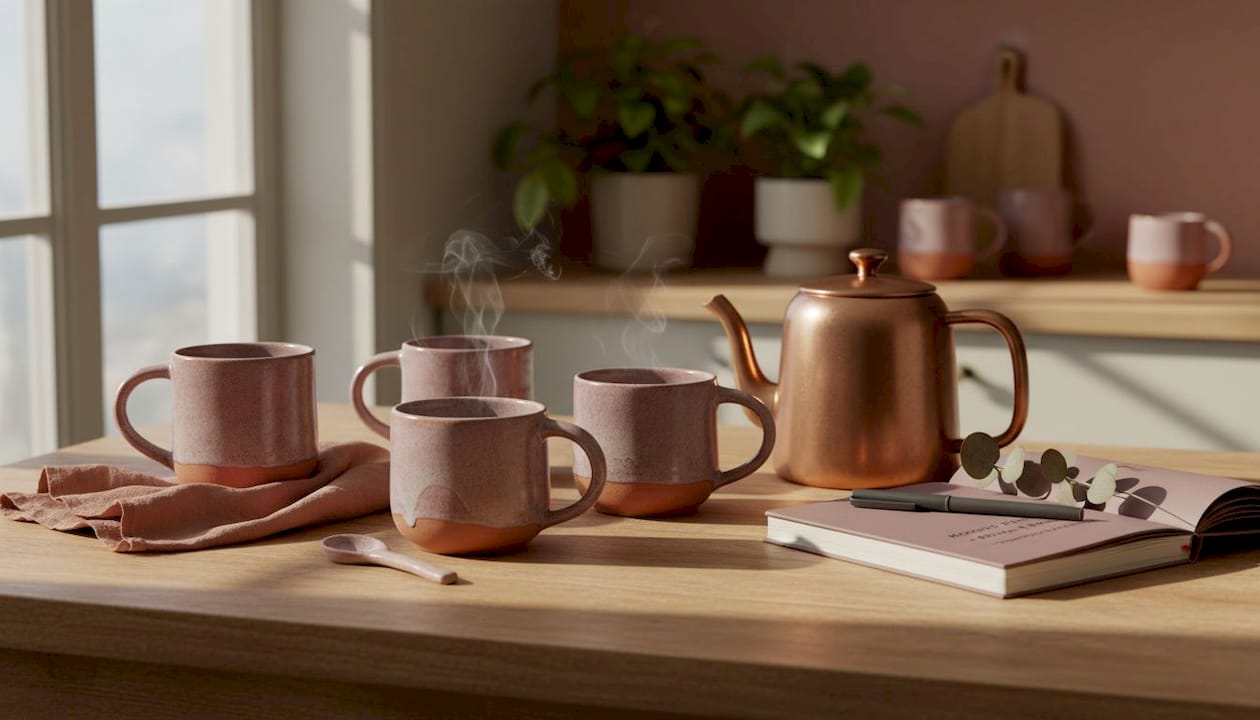
If you are drawn to warmth and depth of colour, warm toned mugs are a particularly compelling place to start. The colour shifts and flame-like glazing effects on kiln-fired pieces are impossible to replicate in factory production.
Pro Tip: Run your finger along the inside rim of any mug before purchasing in person. A sharp or uneven edge suggests rushed finishing and will be noticeable on every sip.
Standout handmade mug collections: Our top picks
With a solid set of criteria, it becomes much easier to spot the collections that genuinely deliver. Here are some of the most celebrated and interesting makers in the handmade mug world, along with what makes each one worth your attention.
Emma Bridgewater is perhaps the most recognisable name in handcrafted earthenware mugs. Based in Stoke-on-Trent, the factory produces 1.9M pieces each year, with each piece touched by approximately 30 pairs of hands during production. The brand is beloved for its charming painted designs, from roses to seasonal motifs, and its mugs are dishwasher-safe, though not always microwave-safe. The earthenware clay body gives these mugs a warm, slightly rustic feel, and the hand-painted detailing is genuinely hard to replicate at scale.
Rookwood Pottery, one of America's oldest art potteries, produces hand-thrown mugs priced around USD $145. These are collector-grade pieces with deep, layered glazes and substantial weight. For someone who wants a mug that doubles as an heirloom, Rookwood delivers.
Jars Ceramistes and their Cantine series represent a European sensibility. The forms are clean and architectural, with glazes that range from warm ochre to deep slate. These are mugs for people who prefer quiet restraint over surface decoration.
Farmhouse Pottery out of Vermont offers collector's editions that pair rustic American craft traditions with a refined modern aesthetic. Their pieces are often sold in limited runs, which adds a layer of giftability.
"The charm of a handmade mug lies precisely in what factory lines cannot produce: the slight wobble of a rim, the way glaze pools differently in every hollow. That individuality is not a compromise. It is the entire point." — Bon Appétit and Wirecutter editors, who praise imperfect handmade charm over mass-produced uniformity.
For those seeking something with a distinctly modern Australian sensibility, a deep forest green mug with kiln-change glazing offers a kind of colour depth that shifts in different light conditions, making the same mug feel slightly different each morning. Similarly, the sculptural quality of a pink cone mug brings a playful elegance to any table setting.
When it comes to gifting handmade mugs, the story behind the piece matters as much as the object itself. A handmade mug carries an implicit message: "I chose something made by a person, for you." That is a very different sentiment from a boxed set purchased on a whim.
Comparing handmade mug collections: Features and functions at a glance
After reviewing individual collections, it is genuinely useful to see those options compared side by side. The table below summarises the key features across some of the most notable collections, giving you a quick reference for practical decision-making.
| Collection | Clay type | Glaze style | Dishwasher safe | Microwave safe | Price range | Best for |
|---|---|---|---|---|---|---|
| Emma Bridgewater | Earthenware | Hand-painted, patterned | Yes | Not always | AUD $40-80 | Gifting, charming décor |
| Rookwood Pottery | Stoneware | Deep layered, artisanal | Yes | Yes | AUD $200+ | Collectors, heirlooms |
| Jars Ceramistes (Cantine) | Stoneware | Matte, architectural | Yes | Yes | AUD $60-100 | Everyday elegant use |
| Farmhouse Pottery | Stoneware | Earthy, minimal | Yes | Yes | AUD $80-120 | Gifting, limited editions |
| Muggie artisan mugs | High-fire stoneware | Kiln-change, reactive | Yes | Check product | AUD $35-75 | Daily ritual, gifting |
One striking figure worth pausing on: Emma Bridgewater's factory touches each piece approximately 30 times during production. That is a remarkable amount of human attention in an era when automation dominates manufacturing. It partly explains why handmade pieces carry emotional weight that a factory-uniform mug simply cannot replicate.
For those building a collection or exploring Australian-made options, the ceramic coffee mug range at Muggie offers a curated selection that emphasises tactile beauty, mindful design, and food-safe materials across every piece.
What the comparison reveals:
- Stoneware consistently outperforms earthenware for daily use in terms of heat retention and durability.
- Matte glazes offer excellent grip but may require more careful cleaning.
- Price does not always predict quality. A well-made $50 stoneware mug may outlast a $150 earthenware piece if used daily.
- Dishwasher compatibility varies even within a single brand's range, so always verify before adding to cart.
Which handmade mug suits your lifestyle?
With options mapped and criteria clear, the final step is matching a mug to your actual life. This is where many people overcomplicate things. The real question is not "which mug is best?" but "which mug fits best into the way I actually drink?"
Here is a practical approach:
-
Identify your primary use. Is this mug for a slow morning coffee ritual, a hurried pre-work brew, or afternoon tea? Daily ritual mugs benefit from generous size (around 350 to 400ml), excellent heat retention, and a comfortable handle. Tea drinkers often prefer wider, shallower forms that allow the tea to cool evenly.
-
Choose your finish based on habit. Glossy glazes are smooth, easy to wipe clean, and resist staining well. Matte and textured finishes offer a better grip and a more organic, tactile feel, though they may need a gentle scrub after strongly pigmented drinks like black tea or coffee. Some prefer glossy for easy cleaning while others gravitate toward matte for its aesthetic and grip.
-
Match size to drink type. A 90ml espresso cup is a completely different object to a 450ml soup-and-coffee mug. Larger mugs (550ml and above) suit heavy coffee drinkers but can feel unwieldy. Think about how full you typically fill a mug and work backwards to the right volume.
-
Consider the occasion. Are you buying for yourself or as a gift? A mug chosen as a gift benefits from a clear visual identity, something with a distinctive glaze or form that the recipient will associate with the occasion. A mug for yourself can be more personal, even quirky.
-
Think about where the mug lives. A mug on an open shelf is as much décor as it is vessel. If your kitchen or dining table has a particular colour palette, a beautifully glazed mug that fits that palette adds to the whole visual experience of your space.
The auspicious cloud mug is a standout option for those who want something that feels considered and celebratory without being over-decorated. Its tactile glaze and gentle form make it equally at home on a breakfast table or wrapped as a gift. For something with more visual warmth and character, the yellow kiln glazed mug brings a retro energy that pairs beautifully with matcha or a well-made flat white.
Pro Tip: If you are gifting a mug and are unsure of the recipient's taste, lean toward a neutral matte finish in an earthy tone. These tend to complement almost any kitchen aesthetic and age beautifully with daily use.
Why imperfection sets handmade mugs apart
Here is something the mainstream homeware industry rarely tells you: the search for a perfectly uniform mug is actually a search for something less valuable, not more.
We have grown so accustomed to factory-standard products that a slight variation in glaze pooling or a gently uneven rim can trigger the assumption that something has gone wrong. But in ceramics, those variations are not errors in the process. They are the process. The kiln does not behave identically in every firing. Clay responds differently to every maker's hands. Glaze reacts unpredictably to temperature.
Bon Appétit and Wirecutter editors consistently favour the imperfect handmade charm of artisanal mugs over the sterile predictability of mass-produced uniformity. This is not sentimentality. It is a recognition that objects made by hand carry a distinct physical character that machines genuinely cannot produce.
What this means for your daily ritual is significant. A mug you have used every morning for three years, one with a particular curve that fits your palm and a glaze that you have watched shift slightly in different seasons of light, becomes an anchor. It is tied to memory, habit, and comfort in a way that a replaceable factory mug never will be. Collectors know this instinctively. They are not seeking perfection. They are seeking character.
This is also why buying a handmade mug for someone else is such a meaningful act. You are not giving them a product. You are giving them an object with the capacity to become part of their daily story. That is rare, and worth seeking out.
Explore and shop artisanal mugs
If anything in this guide has sparked the urge to bring something genuinely beautiful into your kitchen or find a gift that will actually be remembered, you are in the right place.
At Muggie, every mug in the view all ceramic mugs collection is selected for its food-safe materials, artisanal quality, and daily usability. Whether you are looking for a single standout piece or browsing giftable ceramic sets for a birthday, housewarming, or simply to say thank you, the range is designed with real rituals in mind. The auspicious cloud mug is a particular favourite for gifting, combining a tactile glaze with a quietly celebratory presence. Shopping handmade means supporting the makers behind the work, and at Muggie, that always comes through in every piece.
Frequently asked questions
How are handmade mugs different from mass-produced ones?
Handmade mugs involve individual craftsmanship and produce unique shapes, glazes, and minor variations in every piece. Reviewers at Bon Appétit and Wirecutter consistently celebrate this imperfect handmade charm as superior to the sterile uniformity of mass production.
Are handmade mugs dishwasher and microwave safe?
Many handmade mugs are dishwasher-safe, but microwave safety varies. For example, Emma Bridgewater mugs are dishwasher-safe but are not always microwave-safe, so it is always best to check the individual maker's care instructions.
Why do some handmade mugs have unglazed bottoms?
Artisans deliberately leave mug bases unglazed because glazed bottoms stick to kiln shelves during the high-temperature firing process. A smooth, sanded unglazed foot is a sign of careful craftsmanship.
Which types of glazes are best for daily use mugs?
For everyday use, prioritise food-safe glazes and high-fire stoneware. These offer the best combination of durability, heat retention, and safety for both hot and cold beverages.
Can I gift a handmade mug for any occasion?
Absolutely. Handmade mugs are well-suited for birthdays, housewarmings, thank yous, and holidays. The Muggie blog explores exactly why a handmade mug makes such a meaningful and lasting gift for occasions like Mother's Day and beyond.